Adaptive Educational Management in Building an Anti-Bullying Environment and Improving Student Learning Quality
DOI:
https://doi.org/10.38035/dijemss.v7i3.6062Keywords:
Adaptive Education Management, Bullying, Learning Quality, Elementary SchoolAbstract
Bullying in elementary schools seriously harms students' mental health and learning quality. Schools with limited resources need an adaptive management model to tackle this effectively. This research stems from the gap between ideal anti-bullying policies and real-world challenges. It describes and analyzes adaptive education management at SDN 036 Ujungberung and SDN Cibodas 01 to handle bullying and improve student learning. This research employs a qualitative approach with a case study method and applies the management framework (Planning, Organizing, Actuating, and Controlling) as its theoretical basis. Data were collected through in-depth interviews, participatory observation, and documentation studies. The findings indicate that at SDN 036 Ujungberung and SDN Cibodas 01 implements a contextual, flexible, and collaborative model of adaptive education management. (1) Planning is conducted participatively by establishing a Prevention and Handling of Violence Team (TPPK) and designing realistic programs tailored to resource limitations. (2) Organization is dynamic, with all teachers actively involved in prevention and supervision. (3) Implementation is humanistically integrated into routine school activities through education, habituation, and direct mediation. (4) Controlling and follow-up are carried out continuously through simple yet regular evaluations, the results of which are used for tangible program improvements. The primary challenge of limited human resources is overcome through collaboration and role flexibility. In conclusion, contextual and responsive adaptive management builds safe, inclusive, character-focused school cultures. It successfully cuts bullying and boosts learning quality, even in resource-poor settings.
References
Bierman, K. L., & Sanders, M. T. (2020). Teaching Explicit Social-Emotional Skills With Contextual Supports for Students With Intensive Intervention Needs. Journal of Emotional and Behavioral Disorders, 29, 14–23. https://doi.org/10.1177/1063426620957623
Camburn, E., & Barnes, C. A. (2004). Assessing the Validity of a Language Arts Instruction Log through Triangulation. The Elementary School Journal, 105(1), 49–73. https://doi.org/10.1086/428802
Damayanti, D. (2023). Evaluasi Dampak Manajemen Pendidikan Terhadap Bullying Pada Peserta Didik. Ar-Rosikhun Jurnal Manajemen Pendidikan Islam, 3, 45–56. https://doi.org/10.18860/rosikhun.v3i1.23773
Downes, P., & Cefai, C. (2016). How to prevent and tackle bullying and school violence : evidence and practices for strategies for inclusive and safe schools. Dublin City University. https://doi.org/10.2766/0799
Ghofur, A., Purwanti, N. S., & Donsu, J. D. T. (2022). Impact of Bullying and Facts on Victims in Elementary Schools. Open Access Macedonian Journal of Medical Sciences, 9, 115–120. https://doi.org/10.3889/oamjms.2021.7817
Ginanjar, F. A., Hariri, H., Sowiyah, S., & Rini, R. (2024). The Effect of Principal Transformational Leadership on Teacher Performance to Improve Student Achievement: A Literature Review. Edumaspul - Jurnal Pendidikan, 8(1), 159–165. https://doi.org/10.33487/edumaspul.v8i1.5809
Hasibuan, K., & Rizana, R. (2023). The Role of Schools, Parental Responsibilities, and Legal Implications for Bullying in Indonesia. The Easta Journal Law and Human Rights, 2, 1–8. https://doi.org/10.58812/eslhr.v2i01.147
Herawati, H., Yusida, Y., & Diana, D. (2022). Pendidikan Karakter di Bulan Ramadhan selama Pandemi Covid-19 Melalui Pembelajaran Kontekstual. Jurnal Obsesi : Jurnal Pendidikan Anak Usia Dini, 6(4), 3590–3600. https://doi.org/10.31004/obsesi.v6i4.2448
Irianto, B. S., Sutrisno, S., & Suryasaputra, R. (2024). EFFORTS TO STOP BULLYING IN SCHOOLS: STRATEGIES, CHALLENGES AND SOLUTIONS. EQUALEGUM International Law Journal, 84–90. https://doi.org/10.61543/equ.v2i3.78
Jatiningsih, O., Setyowati, R. R. N., Sarmini, S., Harmanto, Listyaningsih, Usmi, R., Zahroh, N. F., & Nugraha, M. B. (2025). Towards a School Without Violence: An Analysis of Teacher’s Understanding of the Anti-Violence Education Policy Permendikbudristek no 46 of 2023 (pp. 477–490). https://doi.org/10.2991/978-2-38476-317-7_49
Kaloeti, D. V. S., Manalu, R., Kristiana, I. F., & Bidzan, M. (2021). The Role of Social Media Use in Peer Bullying Victimization and Onset of Anxiety Among Indonesian Elementary School Children. Frontiers in Psychology, 12. https://doi.org/10.3389/fpsyg.2021.635725
Lin, J. C., & Shih, Y.-H. (2024). Strategies for preventing school bullying—A life education perspective. Frontiers in Psychology, 15. https://doi.org/10.3389/fpsyg.2024.1429215
Mayus, M., & Samudra, A. A. (2024). School-Based Education Program to Solve Bullying Cases in Primary Schools. Open Education Studies, 6. https://doi.org/10.1515/edu-2024-0033
Miftahudin, M., Suharti, L., Sugiarto, A., & Sasongko, G. (2023). Why Does Anti-Bullying Child-Friendly School Program Matter? A Study of Junior High Schools in Indonesia. Journal of Educational and Social Research, 13, 131–131. https://doi.org/10.36941/jesr-2023-0153
Putra, J., Sari, E., & Akbar, M. (2020). Policy Evaluation of Child-Friendly Schools in Depok City; Indonesia. International E-Journal of Educational Studies, 4, 138–148. https://doi.org/10.31458/iejes.693846
Rusli, R., Ramli, N. F. M., Mahmud, M. M., Zakaria, S. F., & Tazijan, F. (2025). Public Perceptions of the Causes of Rising Bullying Cases and Solutions in Malaysian Schools: A Qualitative Study. International Journal of Research and Innovation in Social Science, 9, 403–413. https://doi.org/10.47772/ijriss.2025.924ileiid0042
Salshabila, D. A. R., Muhaimin, M., & Rofiqoh, N. (2025). Social Emotional Character of Bullying Perpetrators in Elementary School with Varying Levels of Aggression. Journal of Integrated Elementary Education, 5, 454–468. https://doi.org/10.21580/jieed.v5i2.28105
Stake, R. E. (2017). Case Study Research and Applications: Design and Methods. Sage Publications.
Sulfemi, W. B., Heryadi, T., & Syarifuddin, S. (2021). The Use of Booklet Media in Managing Bullying Behavior at the Lowest Class School. Proceedings of the 2nd Borobudur International Symposium on Humanities and Social Sciences, BIS-HSS 2020, 18 November 2020, Magelang, Central Java, Indonesia. https://doi.org/10.4108/eai.18-11-2020.2311604
Supiadi, E. (2025). Strategies to Address Bullying in Schools: Building a Positive School Culture Amidst Social Challenges in the Digital Age. Journal of Pedagogi, 2, 164–174. https://doi.org/10.62872/mkac5514
Triyani, W., Pauji, A. I., & Malik, A. (2024). MANAJEMEN LAYANAN BIMBINGAN KONSELING DALAM MENGATASI BULLYING DI SMPN 13 KOTA TASIKMALAYA. Manajerial., 4, 197–210. https://doi.org/10.70143/manajerial.v4i1.351
Wicaksono, V. D. (2023). Anti-bullying Programs in Indonesia: An Integrative Review of Elementary Schools (pp. 712–729). https://doi.org/10.2991/978-2-38476-008-4_77
Yin, R. K. (2018). Case study research and applications: Design and methods. In Journal of Hospitality & Tourism Research (Vol. 53, Issue 5). https://doi.org/10.1177/109634809702100108
Downloads
Published
How to Cite
Issue
Section
License
Copyright (c) 2026 Robian Henri, Sri Handayani

This work is licensed under a Creative Commons Attribution 4.0 International License.
Authors who publish their manuscripts in this journal agree to the following conditions:
- The copyright on each article belongs to the author(s).
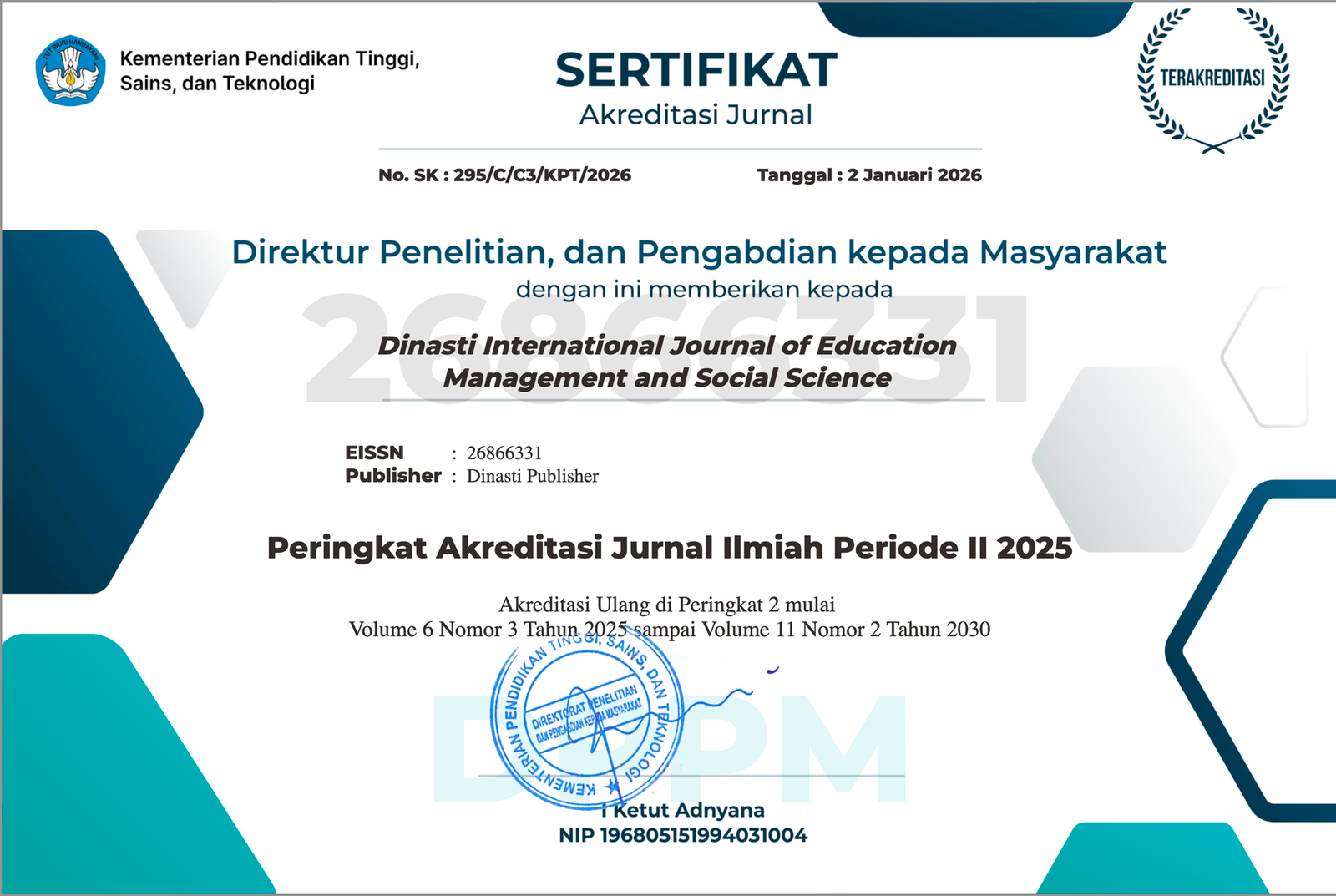
- The author acknowledges that the Dinasti International Journal of Education Management and Social Science (DIJEMSS) has the right to be the first to publish with a Creative Commons Attribution 4.0 International license (Attribution 4.0 International (CC BY 4.0).
- Authors can submit articles separately, arrange for the non-exclusive distribution of manuscripts that have been published in this journal into other versions (e.g., sent to the author's institutional repository, publication into books, etc.), by acknowledging that the manuscript has been published for the first time in the Dinasti International Journal of Education Management and Social Science (DIJEMSS).