The Influence of Knowledge on Performance Mediated by Human Resources in Micro, Small, and Medium Enterprises (MSMEs)
DOI:
https://doi.org/10.38035/dijemss.v7i1.5080Keywords:
Knowledge, Human Resources, Performance, MSMEs, PLS-SEMAbstract
Micro, Small, and Medium Enterprises (MSMEs) in West Java face significant challenges in sustaining their operations amidst digital disruption and increasing market uncertainty. In this environment, knowledge is no longer merely an informational asset but a strategic driver of efficiency, innovation, and customer satisfaction. However, the strategic value of knowledge cannot be fully realized without the support of high quality human resources (HR) capable of interpreting, managing, and applying it in day-to-day business activities. This study aims to examine the influence of knowledge on MSME performance, with HR quality as a mediating variable. Employing a quantitative approach and Partial Least Squares Structural Equation Modeling (PLS-SEM), data were collected from 93 MSME actors in West Java. The findings reveal that both knowledge and human resource quality significantly influence MSME performance, both directly and indirectly. These results underscore that knowledge management when grounded in capable human resources is a critical strategy for driving competitiveness and sustainable growth among MSMEs in the era of digital transformation.
References
Adinda, P., Eviliana, D., Rukhviyanti, N., Systems, I., & Program, S. (2025). Website-Based Baduy Tourism Information System Using The Software Development Life Cycle Method. Jurnal Inovtek Polbeng - Seri Informatika, 10(1), 538–549.
Agasty, S., Tarannum, F., & Narula, S. A. (2023). Sustainability innovation index for micro, small and medium enterprises and their support ecosystems based on an empirical study in India. Journal of Cleaner Production, 415, 137793.
Alfawaire, F., & Atan, T. (2021). The effect of strategic human resource and knowledge management on sustainable competitive advantages at Jordanian universities: The mediating role of organizational innovation. Sustainability, 13(15), 8445.
Borazon, E., Liu, J.-M., & Okumus, F. (2024). Human capital, growth, and competitiveness of Philippine MSMEs: the mediating role of social capital. Asia Pacific Business Review, 30(5), 894–923.
Business, D. (2020). World Bank Group. Línea]. Disponible En.
D’Amato, V., D’Ecclesia, R., & Levantesi, S. (2024). Firms’ profitability and ESG score: A machine learning approach. Applied Stochastic Models in Business and Industry, 40(2), 243–261.
Fatonah, S., & Haryanto, A. T. (2022). Exploring market orientation, product innovation and competitive advantage to enhance the performance of smes under uncertain events. Uncertain Supply Chain Management, 10(1), 161–168. https://doi.org/10.5267/j.uscm.2021.9.011
Harmonia, D., & Agustina, S. (2023). The Relationship Between Management Skills And Financial Management Proficiency In MSMEs. Jurnal Kewirausahaan Dan Manajemen Bisnis: Cuan, 1(4), 40–50.
Le, P. B., & Ha, S. Van. (2024). Impacts of knowledge-based HRM, knowledge sharing and perceived organizational supports on innovation performance: a moderated-mediation analysis. Evidence-Based HRM: A Global Forum for Empirical Scholarship, 12(2), 458–476.
Li, L. (2022). Digital transformation and sustainable performance: The moderating role of market turbulence. Industrial Marketing Management, 104, 28–37.
Liyanage, S. I. H., & Netswera, F. G. (2021). Greening universities with mode 3 and quintuple helix model of innovation–Production of knowledge and innovation in knowledge-based economy, Botswana. In Journal of the Knowledge Economy. Springer.
Lomineishvili, K. (2021). How entrepreneurial management and continuous learning affect the innovation and competitiveness of companies. Economic Alternatives, 27(3), 459–468.
Mio, C., Costantini, A., & Panfilo, S. (2022). Performance measurement tools for sustainable business: A systematic literature review on the sustainability balanced scorecard use. Corporate Social Responsibility and Environmental Management, 29(2), 367–384.
Mohammed Shebeen, T., Shanthi, R., & Mathiyarasan, M. (2024). Navigating Industry 4.0: Skill Development Strategies for Empowering MSMEs in the Digital Age. In Anticipating Future Business Trends: Navigating Artificial Intelligence Innovations: Volume 2 (pp. 453–462). Springer.
Nugraha, B. W., & Rukhviyanti, N. (2024). The Effect of Work Engagement, Work-Life Balance, and Work Overload on Employee Productivity: The Role of Job Satisfaction as A Mediating Variable at BRI Employees in Bandung City. Indonesian Interdisciplinary Journal of Sharia Economics (IIJSE), 7(2), 3808–3833.
Reus, T. H., & Liu, Y. (2021). Rhyme and reason: Emotional capability and the performance of knowledge-intensive work groups. In Emotion and Performance. CRC Press.
Rezaei, F., Khalilzadeh, M., & Soleimani, P. (2021). Factors affecting knowledge management and its effect on organizational performance: Mediating the role of human capital. Advances in Human?Computer Interaction, 2021(1), 8857572.
Ruhviyanti, N., Wasliman, I., Hanafiah, H., & Tejawiani, I. (2022). Implementation Of The Balanced Scorecard In Improving The Performance Of Private Universities. International Journal of Educational Research & Social Sciences, 3(3), 1242–1246. https://doi.org/https://doi.org/10.51601/ijersc.v3i3.390
Russo, D., & Stol, K.-J. (2021). PLS-SEM for software engineering research: An introduction and survey. ACM Computing Surveys (CSUR), 54(4), 1–38.
Santoso, R. A. (2022). Trends in Audit and Good Corporate Governance Research?: A Bibliometric Analysis from 1994 to 2022 Based on Scopus Data. Golden Ratio of Data in Summary, 2(2), 97–106. https://doi.org/https://doi.org/10.52970/grdis.v2i2.660
Santoso, R. A., Rukhviyanti, N., & Hayati, N. (2023). Pemetaan Lanskap Riset Human Development Index dan Technology Menggunakan Data Scopus dengan Analisis Bibliometrik. Media Jurnal Informatika, 15(2), 123. https://doi.org/10.35194/mji.v15i2.3480
Tibbe, T. D., & Montoya, A. K. (2022). Correcting the bias correction for the bootstrap confidence interval in mediation analysis. Frontiers in Psychology, 13, 810258.
Zhang, A. (2024). The Influence of Emotional Intelligence, Knowledge Sharing and Organizational Commitment on Employee Performance of Commercial Banks in Guangdong Province, China. Uniglobal Journal of Social Sciences and Humanities, 3(2), 166–178.
Zvarimwa, C., & Zimuto, J. (2022). Valuable, rare, inimitable, non-substitutable and exploitable (VRINE) resources on competitive advantage. International Journal of Business & Management Sciences, 8(1), 9–22.
Downloads
Published
How to Cite
Issue
Section
License
Copyright (c) 2025 Eddi Supriadi, Vip Paramarta, Kosasih Kosasih, Farida Yuliaty

This work is licensed under a Creative Commons Attribution 4.0 International License.
Authors who publish their manuscripts in this journal agree to the following conditions:
- The copyright on each article belongs to the author(s).
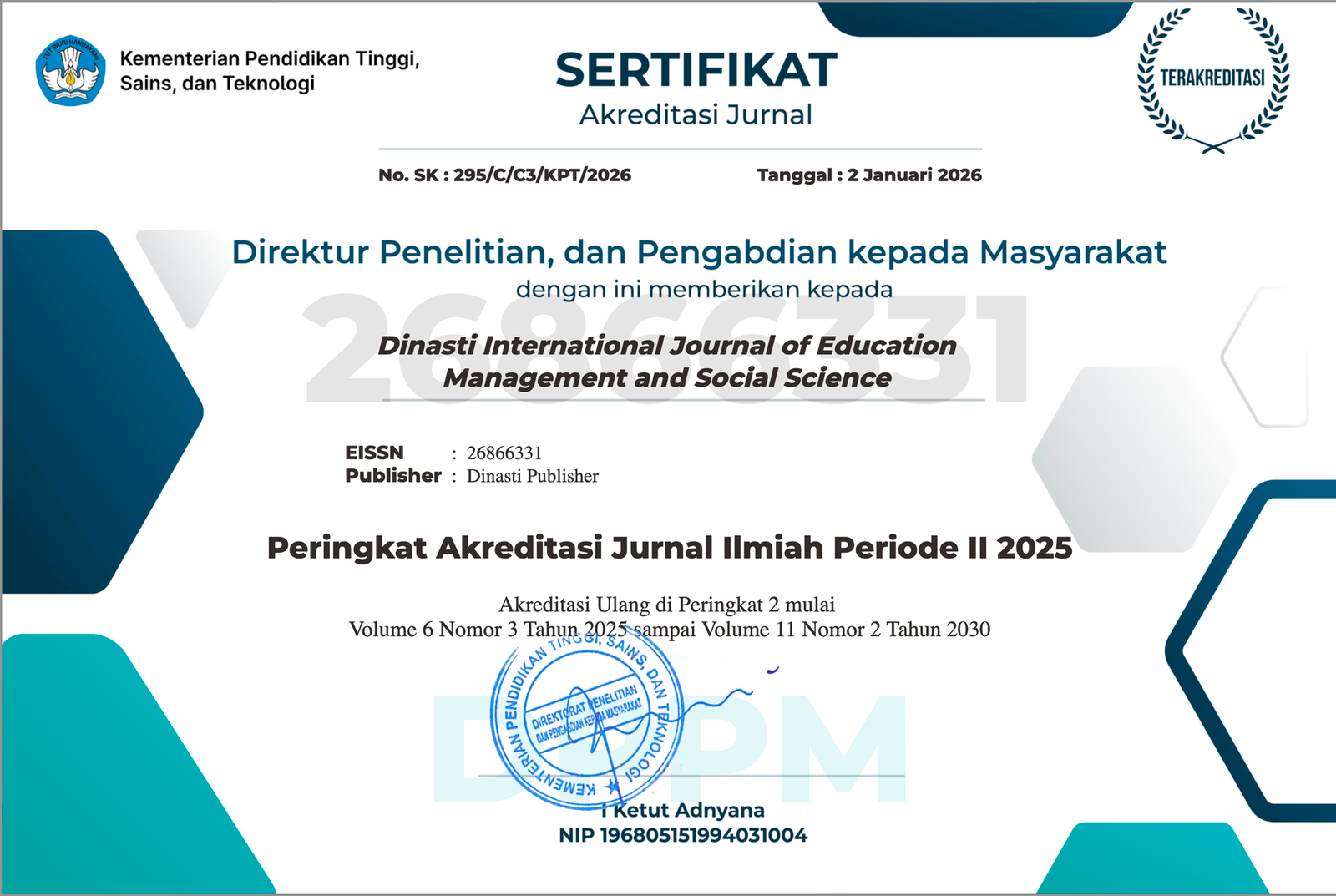
- The author acknowledges that the Dinasti International Journal of Education Management and Social Science (DIJEMSS) has the right to be the first to publish with a Creative Commons Attribution 4.0 International license (Attribution 4.0 International (CC BY 4.0).
- Authors can submit articles separately, arrange for the non-exclusive distribution of manuscripts that have been published in this journal into other versions (e.g., sent to the author's institutional repository, publication into books, etc.), by acknowledging that the manuscript has been published for the first time in the Dinasti International Journal of Education Management and Social Science (DIJEMSS).