The Strategic Role of Digital Trading Communities in Shaping Retail Investor Behavior in Modern Capital Markets
DOI:
https://doi.org/10.38035/dijemss.v7i5.6403Keywords:
Digital Trading Communities, Retail Investors, Financial Management, Behavioral FinanceAbstract
The rapid growth of digital technology has increased retail investor participation through Digital Trading Communities (DTCs), which function as platforms for financial information exchange and social interaction. However, empirical evidence on how these communities influence retail investor behavior and financial decision-making remains limited. This study examines the strategic role of DTCs in shaping investment decisions, risk perception, and personal financial management. A mixed methods approach was employed by combining thematic analysis of discussions in digital trading forums and semi-structured interviews with retail investors, alongside a quantitative survey of 125 active retail investors who are members of digital trading communities. The results show that DTCs facilitate collective learning and help investors interpret market information, thereby reducing uncertainty in investment decisions. However, strong social interaction within these communities also reinforces behavioral biases, particularly herding behavior and overconfidence, which may negatively affect decision quality. This study contributes to the behavioral finance literature by demonstrating how digital community participation simultaneously functions as a learning mechanism and a behavioral risk amplifier. Practically, the findings provide insights for regulators and capital market institutions in promoting digital financial literacy while mitigating behavioral risks in online investment communities.
References
Almufareh, M. F., Tariq, N., Humayun, M., & Almas, B. (2023). A federated learning approach to breast cancer prediction in a collaborative learning framework. Healthcare, 11(24), 3185. https://doi.org/10.3390/healthcare11243185
Alt, R. (2022). Electronic Markets on platform culture. Electronic Markets, 32(3), 1019–1031. https://doi.org/10.1007/s12525-022-00604-5
Bakri, M., Andriani, D., & Bahri, S. (2024). Assessing information processing in capital market structures. Bata Ilyas Educational Management Review, 4(2), 1–13.
Bavoso, V. (2024). Debt capital markets: Law, regulation, and policy. Oxford University Press.
Bertoni, F., Bonini, S., Capizzi, V., Colombo, M. G., & Manigart, S. (2022). Digitization in the market for entrepreneurial finance: Innovative business models and new financing channels. Entrepreneurship Theory and Practice, 46(5), 1120–1135. https://doi.org/10.1177/10422587211038480
Bhanu, B. K. (2023). Behavioral finance and stock market anomalies: Exploring psychological factors influencing investment decisions. Commer. Econ. Manag, 23.
Challa, S. R. (2025). Advancements in digital brokerage and algorithmic trading: The evolution of investment platforms in a data-driven financial ecosystem. Advances in Consumer Research, 2(1).
Elgayar, A. H. (2021). The impact of investor sentiment and herding behaviour on stock market liquidity.
Garay, U., & Pulga, F. (2021). The performance of retail investors, trading intensity and time in the market: Evidence from an emerging stock market. Heliyon, 7(12), e08583. https://doi.org/10.1016/j.heliyon.2021.e08583
Gaspar, R. M., Henriques, P. L., & Corrente, A. R. (2020). Trust in financial markets: The role of the human element. Revista Brasileira de Gestão de Negócios, 22(3), 647–668. https://doi.org/10.7819/rbgn.v22i3.4072
Gökalp, M. O., Kayabay, K., Gökalp, E., Koçyiğit, A., & Eren, P. E. (2020). Towards a model based process assessment for data analytics: An exploratory case study. In European Conference on Software Process Improvement (pp. 617–628).
Gokhale, G. M., & Mittal, A. (2024). Exploring the nexus of capital market and investor behaviour: A systematic literature review. International Journal of Economics and Financial Issues, 14(2), 65.
Goldstein, I. (2023). Information in financial markets and its real effects. Review of Finance, 27(1), 1–32. https://doi.org/10.1093/rof/rfac052
Hala, Y., Abdullah, M. W., Andayani, W., Ilyas, G. B., & Akob, M. (2020). The financial behavior of investment decision making between real and financial assets sectors. The Journal of Asian Finance, Economics and Business, 7(12), 635–645. https://doi.org/10.13106/jafeb.2020.vol7.no12.635
Hanif, R., Astuti, W., & Sunardi, S. (2024). The mediating role of customer satisfaction in the effect of perceived enjoyment on customer trust in online investment application. Innovation Business Management and Accounting Journal, 3(1), 18–29.
Harasim, J. (2022). FinTechs, BigTechs and structural changes in capital markets. In The digitalization of financial markets. Taylor & Francis.
He, H., Jones, L., Lu, Y., & Gepp, A. (2025). Technology-enabled innovations in financial markets and retail investors: A systematic literature review. Journal of Accounting Literature.
Khan, M. A., & Shabbir, H. (2025). The digital literacy and retail investing: Exploring market dynamics, efficiency, and stability in the digital era. Journal of Digital Literacy and Learning.
McBride, K. A., MacMillan, F., George, E. S., & Steiner, G. Z. (2019). The use of mixed methods in research. In Handbook of research methods in health social sciences (pp. 695–713). Springer.
Mezmir, E. A. (2020). Qualitative data analysis: An overview of data reduction, data display, and interpretation. Research on Humanities and Social Sciences, 10(21), 15–27.
Mirhosseini, S.-A. (2020). Diverse sources of qualitative data. In Doing qualitative research in language education (pp. 111–129). Springer.
Naveed, M., Farah, M. F., & Hasni, M. J. S. (2021). The transformative role of firm information transparency in triggering retail investor’s perceived financial well-being. International Journal of Bank Marketing, 39(7), 1091–1113. https://doi.org/10.1108/IJBM-02-2021-0068
Nourallah, M., Öhman, P., & Amin, M. (2023). No trust, no use: How young retail investors build initial trust in financial robo-advisors. Journal of Financial Reporting and Accounting, 21(1), 60–82. https://doi.org/10.1108/JFRA-12-2021-0451
Nurhayati, N. (2023). Digital innovation in halal logistics: An Indonesian case study. Agripreneur: Jurnal Pertanian Agribisnis, 12(2), 23–37.
Nurhayati, N., Chelbi, A., Mabrouk, A. B., & Young, F. C. (2025). Unleashing halal potential: Exploring the dynamics of halal logistics in Tangerang City, Indonesia. Agrociencia, 1–13.
Pa, A. N. P., Wiksuana, I. G. B., Suartana, I. W., & Artini, L. G. S. (2022). The influence of social and personal factors in individual investment decision making. Calitatea, 23(191), 80–88.
Rahayu, A. D., Putra, A., Oktaverina, C., & Ningtyas, R. A. (2021). Herding behavior in the stock market: A literature review. International Journal of Social Sciences Review, 1(2), 8–25.
Rahayu, S., Rohman, A., & Harto, P. (2021). Herding behavior model in investment decision on emerging markets: Experimental in Indonesia. The Journal of Asian Finance, Economics and Business, 8(1), 53–59. https://doi.org/10.13106/jafeb.2021.vol8.no1.053
Rahman, K. O., Hasan, M., Khanam, A., Nasrullah, F., Mia, M. M., Jishan, S. S., & Rezvi, R. I. (2025). Investment & market growth analysis: Insights into US retail stock performance, emerging players, M&A trends. Journal of Economics, Finance and Accounting Studies, 7(3), 112–117.
Raja, E. L. A., & Abdelaziz, M. (2025). Rationality, intuition, and behavioral biases in investment decisions: Bridging classical finance and behavioral finance with evidence from Morocco. International Journal of Applied Management and Economics, 2(17), 167–187.
Raut, R. K. (2020). Past behaviour, financial literacy and investment decision-making process of individual investors. International Journal of Emerging Markets, 15(6), 1243–1263. https://doi.org/10.1108/IJOEM-07-2018-0379
Raut, R. K., & Kumar, S. (2024). An integrated approach of TAM and TPB with financial literacy and perceived risk for influence on online trading intention. Digital Policy, Regulation and Governance, 26(2), 135–152. https://doi.org/10.1108/DPRG-07-2023-0101
Rodpangtiam, A., Boonchutima, S., & Mazahir, I. (2024). Perception of social media users regarding cryptocurrency investment adoption: A case of social media platform–Reddit. Cogent Business & Management, 11(1), 2402513. https://doi.org/10.1080/23311975.2024.2402513
Sahu, M., Uddin, F., & Hossain, M. B. (2025). Exploring the psychological drivers of cryptocurrency investment biases: Evidence from Indian retail investors. International Journal of Financial Studies, 13(4), 219.
Sattar, M. A., Toseef, M., & Sattar, M. F. (2020). Behavioral finance biases in investment decision making. International Journal of Accounting, Finance and Risk Management, 5(2), 69–75. https://doi.org/10.11648/j.ijafrm.20200502.11
Selvakumar, P., Mishra, R. K., Budhiraja, A., Dahake, P. S., Chandel, P. S., & Vats, C. (2025). Social media influence on market sentiment. In Unveiling investor biases that shape market dynamics (pp. 225–250). IGI Global Scientific Publishing.
Siriwardana, A., & Mendis, M. (2019). Social media marketing: A conceptual review on applications. Journal of Business and Management, 21(5), 54–60.
Vinoth Balaji, V., & Sriram, M. (2024). Case study on retail investors: Technological innovation and stock market dynamics. Journal of Information Technology Teaching Cases.
Wilson, G., Johnson, O., & Brown, W. (2024). Exploring the impact of digital transformation on marketing strategies in the retail sector.
Woods, C. (2021). Interrogating digital rhetorical privacy on direct-to-consumer genetics websites (Doctoral dissertation, Illinois State University).
Yoon, J., & Oh, G. (2022). Investor herding behavior in social media sentiment. Frontiers in Physics, 10, 1023071. https://doi.org/10.3389/fphy.2022.1023071
Zheng, X. (2021). Data collection in quantitative research. In Research methods for student radiographers (pp. 79–92). CRC Press.
Downloads
Published
How to Cite
Issue
Section
License
Copyright (c) 2026 Dewi Permata Sari, Maya Sova, Mulyadi Mulyadi, Arum Indrasari, Mohammad Hisam

This work is licensed under a Creative Commons Attribution 4.0 International License.
Authors who publish their manuscripts in this journal agree to the following conditions:
- The copyright on each article belongs to the author(s).
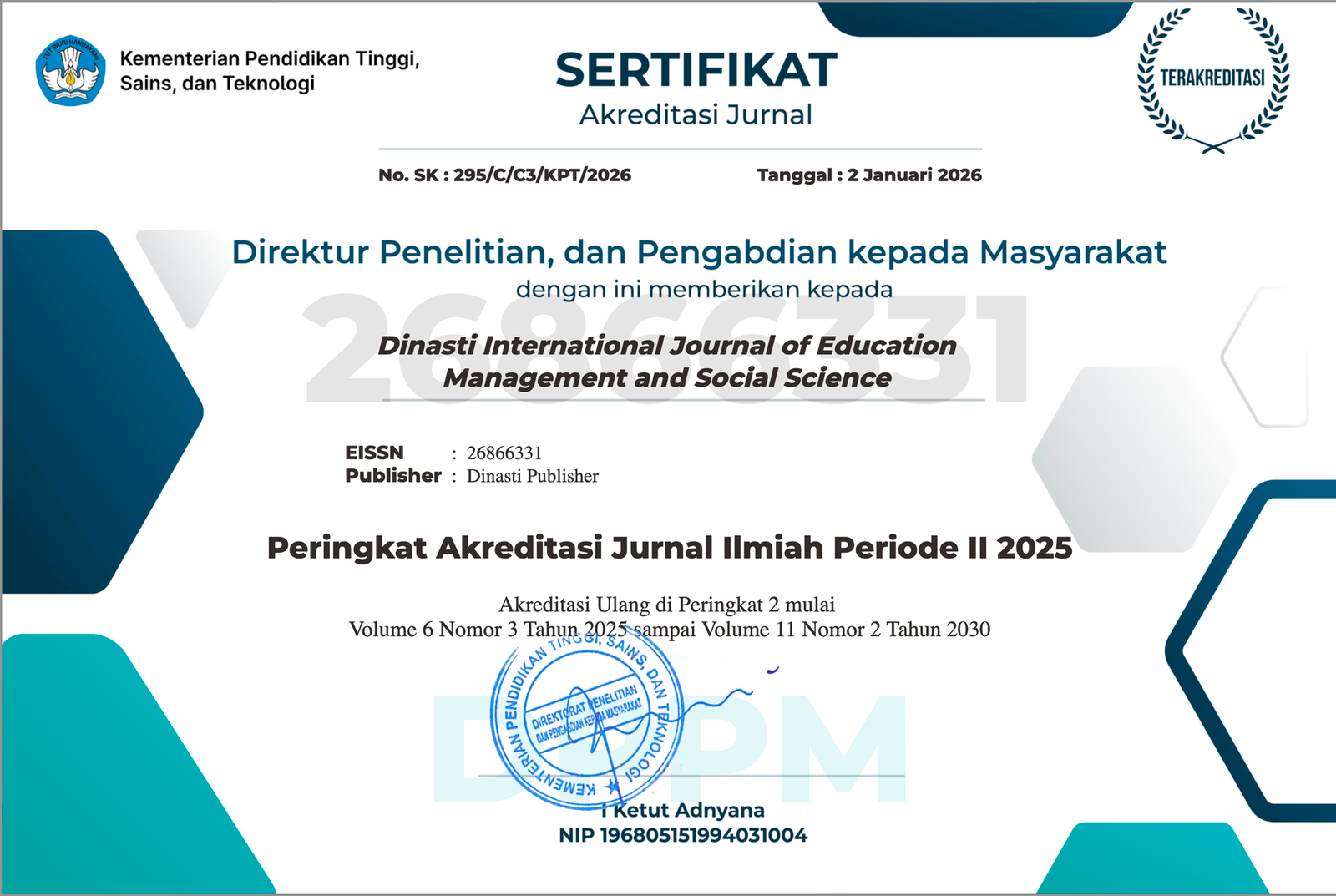
- The author acknowledges that the Dinasti International Journal of Education Management and Social Science (DIJEMSS) has the right to be the first to publish with a Creative Commons Attribution 4.0 International license (Attribution 4.0 International (CC BY 4.0).
- Authors can submit articles separately, arrange for the non-exclusive distribution of manuscripts that have been published in this journal into other versions (e.g., sent to the author's institutional repository, publication into books, etc.), by acknowledging that the manuscript has been published for the first time in the Dinasti International Journal of Education Management and Social Science (DIJEMSS).