Drivers of Organizational Performance in Accounting Firms: Price Competition, Professional Standards (SPJA) Effectiveness, and Firm Reputation under the Moderating Role of Professional Regulation
DOI:
https://doi.org/10.38035/dijefa.v6i6.5608Keywords:
Accounting Service Firm (KJA), Price Competition, SPJA, Reputation, Regulation, KJA PerformanceAbstract
Accounting Service Firms (KJA) play a vital role in supporting SMEs in Indonesia, yet they face challenges from price competition and dynamic of accountant professional regulations. This study aims to analyze the effects of price competition, the effectiveness of implementing the Standards of Accountants Services (SPJA), and reputation on organizational performance, with the regulation of the accounting profession as a moderating variable. A quantitative approach with an explanatory survey was employed, targeting 500 KJA registered on the Find KJA IAI Global platform as of May 5, 2025, with 144 firms participating. Data were analyzed using Partial Least Squares–Structural Equation Modeling (PLS-SEM). The findings reveal that price competition and effective SPJA implementation have positive and significant effects on organizational performance, whereas firm reputation does not show a significant effect. Moreover, accountant professional regulation does not strengthen these relationships; instead, it tends to weaken the effect of SPJA effectiveness on performance. These results suggest that for small-medium scale KJA, accountant professional regulations are perceived more as an administrative burden than as strategic support. This study underscores competitive pricing and effective SPJA implementation as the main drivers of KJA performance, while reputation has yet to emerge as a determining factor. Theoretically, the findings challenge the relevance of Public Interest Theory and Interest Group Theory in the context of smaller KJA, while practically highlighting the need for proportional regulations that focus on strengthening internal capabilities.
References
Anggani, M. P., Nurhayati, I. D., & Puspitosarie, E. (2023). The effect of the implementation of quality control standards (SPM) on audit quality at public accounting firm (KAP) in Malang. In Proceedings of the Conference on Economic and Business Innovation (CEBI) (Vol. 3, No. 1, pp. 316–333). https://doi.org/10.31328/cebi.v3i1.378
Anggraita, V., Fitriany, F., Sinaga, R., & Kiantara, R. F. (2024). Evaluating Audit Market Competition And Pricing In Indonesia. Keunis, 12(1), 68-80. https://doi.org/10.32497/keunis.v12i1.4470
Aula, P., & Heinonen, J. (2016). Reputation. In The reputable firm: How digitalization of communication is revolutionizing reputation management (pp. 1–34). Springer. https://doi.org/10.1007/978-3-319-24154-8_1
Azizkhani, M., Sami, H., Amirkhani, K., & Monroe, G. S. (2022). Competition Effects on Audit Quality and Pricing in a Non-Big 4 Market. The International Journal of Accounting, 57(04). https://doi.org/10.1142/s1094406022500159
Barney, J. B., Wright, M., & Ketchen, D. J. (2001). The resource-based view of the firm: Ten years after 1991. Journal of Management, 27(6), 625–641. https://doi.org/10.1177/014920630102700601
Coetzee, C., Barac, K., & Seligmann, J. (2019). Institutional logics and sustainability of selected small and medium-sized audit firms. South African Journal of Accounting Research, 33(3), 163–186. https://doi.org/10.1080/10291954.2019.1655189
Coombs, W.T., & Holladay, S.J. (2002). Helping Crisis Managers Protect Reputational Assets. Management Communication Quarterly, 16, 165 - 186. https://doi.org/10.1177/089331802237233
Creswell, J.W. and Plano Clark, V.L. (2011) Designing and Conducting Mixed Methods Research. 2nd Edition, Sage Publications, Los Angeles.
Crook, T. R., Todd, S. Y., Combs, J. G., Woehr, D. J., & Ketchen, D. J. (2011). Does human capital matter? A meta-analysis of the relationship between human capital and firm performance. Journal of Applied Psychology, 96(3), 443–456. https://doi.org/10.1037/a0022147
Desai, N., Mishra, B., Mock, T. J., & Purohit, S. (2025). The effects of audit partner industry experience on lowballing, subsequent audit fees, and audit quality. Auditing: A Journal of Practice & Theory, 44(3), 85–110. https://doi.org/10.2308/AJPT-2022-133
Fombrun, C., & Shanley, M. (1990). What’s in a Name? Reputation Building and Corporate Strategy. The Academy of Management Journal, 33(2), 233–258. https://doi.org/10.2307/256324
Hair, J.F., Hult, G.T.M., Ringle, C.M. and Sarstedt, M. (2017) A Primer on Partial Least Squares Structural Equation Modeling (PLS-SEM). 2nd Edition, Sage Publications Inc., Thousand Oaks, CA.
Kaplan, R.S. and Norton, D.P. (1996), "Strategic Learning & The Balanced Scorecard", Strategy & Leadership, Vol. 24 No. 5, pp. 18-24. https://doi.org/10.1108/eb054566
Kotler, P. T., & Armstrong, G. (2020). Principles of marketing (18th ed.). Pearson Education.
Kuntadi, C. (2020). The effect of lowballing on auditor independence and audit opinion: Case study at the Public Accounting Office for the Special Capital Region of Jakarta. Research Journal of Finance and Accounting, 11(4). https://doi.org/10.7176/RJFA/11-4-05
Li, X., & Wei, Y. (2023). The Impact of Price Competition on Profitability in Service Sectors. Journal of Service Management.
Mahendra, D., & Soedibyo, A. N. (2023). Evaluasi penerapan risk-based audit untuk mendeteksi ketidakpatuhan akuntan publik terhadap standar profesi dan regulasi. Owner: Riset dan Jurnal Akuntansi, 7(2), 1707–1719. https://doi.org/10.33395/owner.v7i2.1387
Nisrina, N. (2021). Product Market Competition and Audit Fees: Auditor Industry Specialization as A Moderating Variable. Jurnal Dinamika Akuntansi dan Bisnis, 8(1), 91-104. https://doi.org/10.24815/jdab.v8i1.19486
Scott, W. R. (2015). Institutional Theory: The Institutional Context of Organizational Change. Sage Publications.
Sugiyono. (2017). Metode Penelitian Pendidikan Pendekatan Kuantitatif, Kualitatif, dan R&D. Bandung: Alfabeta.
Suherman, N. F. D., & Aryati, T. (2022). Pengaruh Defisiensi Sistem Pengendalian Mutu (Spm) Dan Ukuran Kantor Akuntan Publik Terhadap Defisiensi Audit. Jurnal Ekonomi Trisakti, 2(2), 357-368. http://dx.doi.org/10.25105/jet.v2i2.14180
Tanjoyo, C., Harianto, E., Sutrisno, T. F. C. W. (2021). The Role of TQM and Organizational Culture on Operational Performance. Jurnal Aplikasi Manajemen, Volume 19, Issue 4.
Ukrinas, R., & Ambrasė, N. (2025). Theoretical basis for the perception and identification of organisational reputation. Laisvalaikio tyrimai. https://doi.org/10.33607/elt.v1i25.1629
Wahyuni, S., & Suprapti, E. (2024). Pengaruh Ukuran Kantor Akuntan Publik (KAP), Ukuran Perusahaan, Dan Fee Audit Terhadap Kualitas Audit (Studi Empiris Pada Perusahaan Manufaktur Pada Sektor Barang Konsumsi Yang Terdaftar Di Bursa Efek Indonesia (BEI) Periode 2020-2022). Journal of Global and Multidisciplinary Volume 2, Issue 2.
Yasmin, E. (2023). Pengaruh Rotasi KAP, Tenure Audit dan Ukuran Perusahaan Terhadap Kualitas Audit Pada Perusahaan Manufaktur. Journal Of Culture Accounting And Auditing, 2(1), 13-22. http://dx.doi.org/10.30587/jcaa.v2i1.4839
Zainal Abidin, N. H., Nelson, S. P., & Ahmad, M. (2021). Ensuring auditor independence: The case for small and medium practices in Malaysia. Asian Journal of Accounting Perspectives, 14(1), 98–119. https://doi.org/10.22452/AJAP.vol14no1.5
Zhang, S., & Wei, L. (2023). Does regional audit market competition influence audit pricing? Evidence based on the spatial distribution of the audit market. Finance Research Letters, 58, 104539. https://doi.org/10.1016/j.frl.2023.104539
Downloads
Published
How to Cite
Issue
Section
License
Copyright (c) 2025 Monica Widyati Wijono, Eric Harianto, Damelina Basauli Tambunan

This work is licensed under a Creative Commons Attribution 4.0 International License.
Authors who publish their manuscripts in this journal agree to the following conditions:
- The copyright on each article belongs to the author(s).
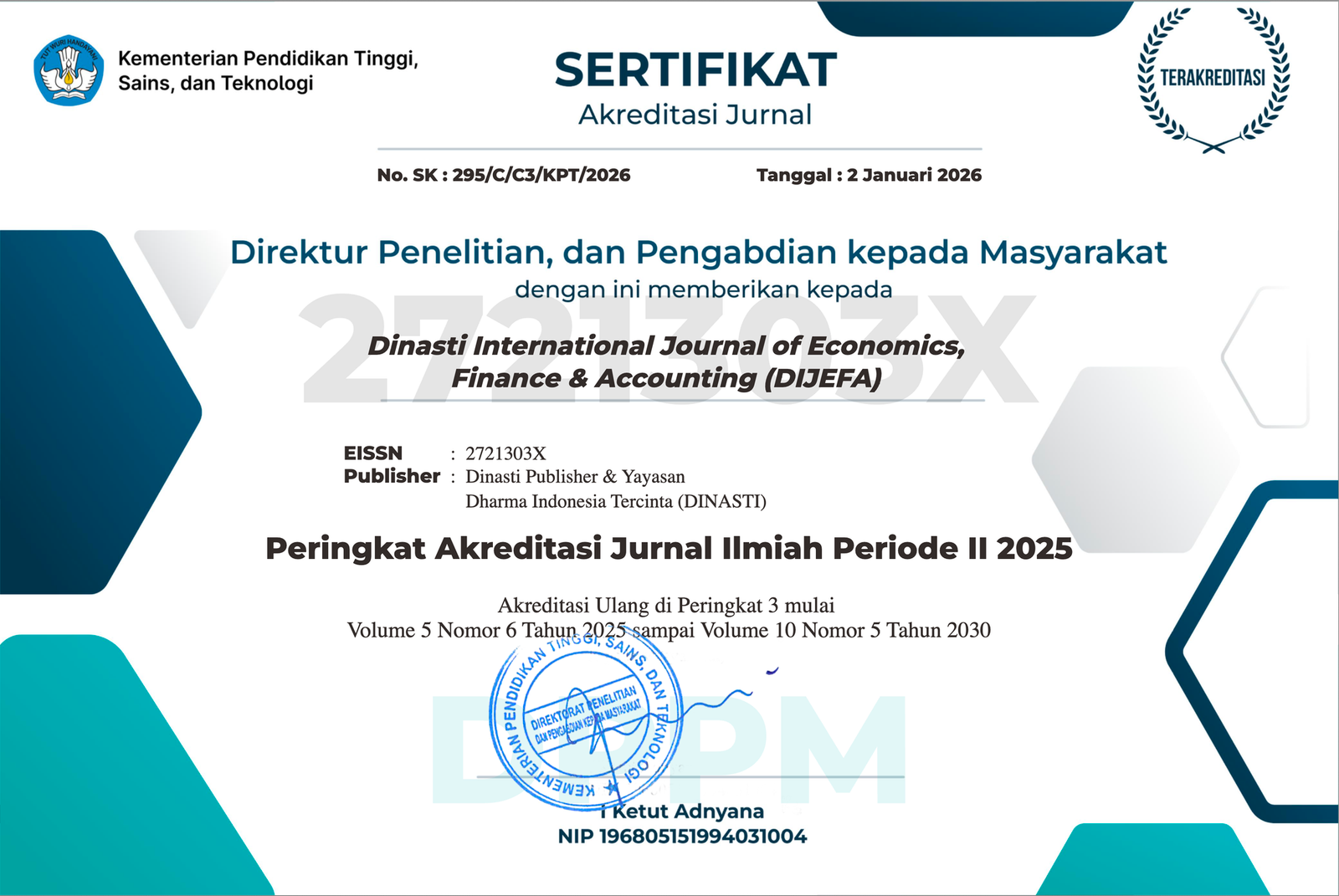
- The author acknowledges that the Dinasti International Journal of Economics, Finance & Accounting (DIJEFA) has the right to be the first to publish with a Creative Commons Attribution 4.0 International license (Attribution 4.0 International (CC BY 4.0).
- Authors can submit articles separately, arrange for the non-exclusive distribution of manuscripts that have been published in this journal into other versions (e.g., sent to the author's institutional repository, publication into books, etc.), by acknowledging that the manuscript has been published for the first time in the Dinasti International Journal of Economics, Finance & Accounting (DIJEFA).