The Mediating Role of Labour Force Partisipation Rate in the Effects of Domestic and Foreign Direct Investment on Poverty in East Kalimantan Province
DOI:
https://doi.org/10.38035/dijefa.v7i4.7321Keywords:
DDI, FDI, LFPR, Poverty, StataAbstract
This study aims to determine the influence of Domestic Direct Investment (DDI) and Foreign Direct Investment (FDI) on Poverty through the labor force participation rate (LFPR) in districts/cities of East Kalimantan Province. This study uses a quantitative approach. The data used are secondary data obtained through publications and surveys. The type of data is panel data for 10 districts/cities in East Kalimantan Province for the 2015–2025 period with 110 observations. The analysis tool uses path analysis with the help of STATA 17.0 software. The results of the study showed that DDI had a significant effect on LFPR, and FDI had an insignificant effect on LFPR. DDI also and significant effect on poverty, while FDI had an insignificant effect. Furthermore, LFPR has a significant effect on poverty, which shows that the increase in the participation of the working-age population in the labor market is related to poverty reduction. However, the results of mediation testing showed that LFPR did not significantly mediate the influence of DDI or FDI on poverty. Research implications emphasize investment aimed at productive job creation, human resource quality, local worker involvement, and stronger regional economic linkages, particularly amid the economic transformation and urban development in East Kalimantan.
References
Alkire, S., Kanagaratnam, U., & Suppa, N. (2018). OPHI MPI METHODOLOGICAL NOTES 46 The Global Multidimensional Poverty Index (MPI): 2018 Revision.
Anam, C. P. M. V. V. D. C. C. (2023). Village Funds and Poverty Reduction in Indonesia: New Policy Insight. Discover Global Society, 1(1), 1–14. https://doi.org/https://doi.org/10.1007/s44282-023-00016-6.
Ayu Agustina, L., Iqbal, M., & Bahtiar, M. Y. (2026). The Effect Of Domestic Investment And Foreign Direct Investment On The Increase Labor Absorption In Indonesia During 2015–2024: An Islamic Economics Perspective. Journal of Contemporary Applied Islamic Philanthropy, 4(1), 97–110. https://doi.org/10.62265/jcaip.v4i1.579
Balboni, C. B. O. B. R. G. M. H. A. (2022). Why do people stay poor? The Quarterly Journal of Economics, 137(2), 785–844. https://doi.org/https://doi.org/10.1093/qje/qjab045
Barrett, C. B. (2005). Rural poverty dynamics: Development policy implications. Agricultural Economics, 32, 45–60. https://doi.org/https://doi.org/10.1111/j.0169-5150.2004.000
Barrett, C. B. G. T. M. L. (2016). Well-being dynamics and poverty traps. Annual Review of Resource Economics, 8, 303–327. https://doi.org/https://doi.org/10.1146/annurevresource-100815-095235
Carter, M. R., & Barrett, C. B. (2006). The economics of poverty traps and persistent poverty: An asset-based approach. Journal of Development Studies, 42(2), 178–199. https://doi.org/10.1080/00220380500405261
Ernawati, E. T. T. N. S. (2021). Does Government Expenditure Affect Regional Inclusive Growth? An Experience of Implementing Village Fund Policy in Indonesia. Economies, 9(4), 164. https://doi.org/https://doi.org/10.3390/economies9040164.
Haq, W., Azam, M., Babar, Z., Amir, S., & Said, F. (2024). Investigation of multidimensional poverty in Pakistan at the national, regional, and provincial level. In Humanities and Social Sciences Communications (Vol. 11, Number 1). Springer Nature. https://doi.org/10.1057/s41599-024-03005-5
Kataoka, M. (2019). Interprovincial Differences in Labour Force Distribution and Utilization based on Educational Attainment in Indonesi. Regional Science Policy & Practice, 11(1), 39–54. https://doi.org/https://doi.org/10.1111/rsp3.12159
Kusumawardhani, N. P. R. S. N. S. S. D. (2023). Heterogeneous Impact of Internet Availability on Female Labor Market Outcomes in an Emerging Economy: Evidence from Indonesia. World Development, 164(11). https://doi.org/https://doi.org/10.1016/j.worlddev.2022.106182.
Kwak, S. S. S. C. (2013). Regional agricultural endowments and shifts of poverty trap equilibria: Evidence from Ethiopian Panel Data. The Journal of Development Studies, 49(7), 955–975. https://doi.org/https://doi.org/10.1080/00220388.2013.785523
Muna, R., Abrar, M., & Nasir, M. (2024). The Effect of Domestic Investment, Foreign Investment, Labor, Unemployment, Human Development Index, and Inflation on Poverty in Indonesia. International Journal of Finance, Economics and Business, 3(2), 85–92. https://doi.org/10.56225/ijfeb.v3i2.309
Nunes, C. (2008). Working Paper Series Poverty Measurement: The Development of Different Approaches and Its Techniques. www.ecineq.org
Rada, C., & Schiavone, A. (2025). Structural Change and the Labor Share: Insights From Baumol and Lewis. Metroeconomica. https://doi.org/10.1111/meca.70004
Rahma, A., & Syafii, M. (2026). Multidisciplinary Output Research For Actual and International Issue. MORFAI Journal) ISSN, 6(1), 2808–6635. https://doi.org/10.54443/morfai.v6i1.4732
Rammohan, A. T. A. (2023). Rural Poverty and Labour Force Participation: Evidence from Indonesia’s Village Fund Program. PLoS ONE, 18, 1–15. https://doi.org/https://doi.org/10.1371/journal.pone.0283041
Sartika, N. (2024). How is Economic Structure Transformed? Evidence: West Kalimantan Province of Indonesia. SRIWIJAYA INTERNATIONAL JOURNAL OF DYNAMIC ECONOMICS AND BUSINESS, 45–64. https://doi.org/10.29259/sijdeb.v8i1.45-64
Streiner, D. L. (2005). Finding Our Way: An Introduction to Path Analysis. Canadian Journal of Psychiatry. Canadian Journal of Psychiatry, 50(2), 115–122.
Wayus, D., & Syarief, S. (2025). The Impact of Investment and Labor Force Participation on Poverty in Aceh: The Mediating Role of Per Capita Income. Signifikan: Jurnal Ilmu Ekonomi, 14(2), 505–520. https://doi.org/10.15408/sjie.v13i2.46434.
Downloads
Published
How to Cite
Issue
Section
License
Copyright (c) 2026 Lisa Sari, Muhammad Bayu, Aning Kesuma Putri

This work is licensed under a Creative Commons Attribution 4.0 International License.
Authors who publish their manuscripts in this journal agree to the following conditions:
- The copyright on each article belongs to the author(s).
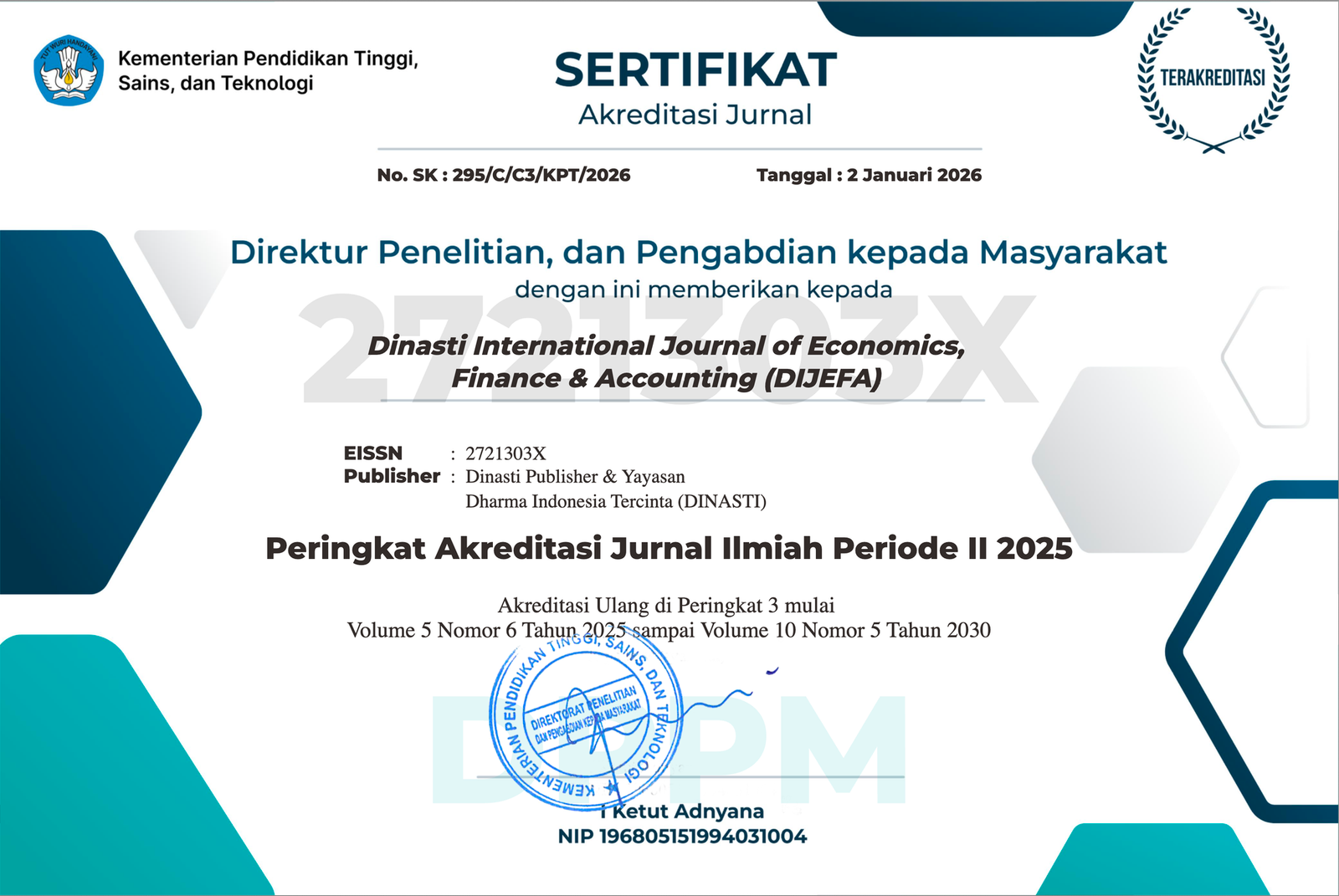
- The author acknowledges that the Dinasti International Journal of Economics, Finance & Accounting (DIJEFA) has the right to be the first to publish with a Creative Commons Attribution 4.0 International license (Attribution 4.0 International (CC BY 4.0).
- Authors can submit articles separately, arrange for the non-exclusive distribution of manuscripts that have been published in this journal into other versions (e.g., sent to the author's institutional repository, publication into books, etc.), by acknowledging that the manuscript has been published for the first time in the Dinasti International Journal of Economics, Finance & Accounting (DIJEFA).