ESG Disclosure and Firm Value: The Moderating Role of Competitive Advantage
DOI:
https://doi.org/10.38035/dijefa.v7i3.6995Keywords:
Environmental, Social, and Governance (ESG) Disclosure, Firm Value, Competitive AdvantageAbstract
Environmental, social, and governance (ESG) disclosure has been increasingly recognized as a significant determinant of firm value; however, its effectiveness is believed to be influenced by the firm's internal conditions, particularly its competitive advantage. This study aims to examine the effect of ESG disclosure on firm value and to investigate the moderating role of competitive advantage in this relationship. The research sample comprises companies listed on the ESG Quality 45 KEHATI Index of the Indonesia Stock Exchange over the period 2021–2024. Moderated regression analysis was employed using EViews software. The results indicate that ESG disclosure positively affects firm value, suggesting that sustainability transparency enhances stakeholder trust and drives higher market valuations. Furthermore, competitive advantage is found to significantly strengthen the positive effect of environmental, ESG disclosure on firm value, indicating that firms with stronger competitive positions are better able to leverage their sustainability disclosure in creating value for stakeholders. These findings enrich the application of stakeholder theory by establishing that competitive advantage serves as a critical boundary condition that determines the effectiveness of environmental, social, and governance disclosure in enhancing firm value.
References
Al-Tarawneh, A., Tayeh, M., Iskandrani, M., & Obeidat, M. (2024). The impact of ESG scores on corporate financial performance: A study of non-financial firms listed in the UK. Asian Economic and Financial Review, 14(11), 852–867. https://doi.org/10.55493/5002.v14i11.5229
Alareeni, B. A., & Hamdan, A. (2020). ESG impact on performance of US S&P 500-listed firms. Corporate Governance (Bingley), 20(7), 1409–1428. https://doi.org/10.1108/CG-06-2020-0258
Au, A. K. M., Yang, Y.-F., Wang, H., Chen, R.-H., & Zheng, L. J. (2023). Mapping the Landscape of ESG Strategies: A Bibliometric Review and Recommendations for Future Research. Sustainability, 15(24), 16592. https://doi.org/10.3390/su152416592
Aydoğmuş, M., Gülay, G., & Ergun, K. (2022). Impact of ESG performance on firm value and profitability. Borsa Istanbul Review, 22, S119–S127. https://doi.org/10.1016/j.bir.2022.11.006
Bloomberg L.P. (2006). Annual data on ESG Disclosure, Tobin’s Q, Return on Invested Capital, Weighted Average Cost of Capital, Return on Asset, Current Ratio, Total Debt to Total Assets, Total Assets for firms that were listed in ESG Quality 45 KEHATI Index from 2010 to 2020.
Dkhili, H. (2024). Does environmental , social and governance ( ESG ) a ff ect market performance ? The moderating role of competitive advantage. 34(2), 327–352. https://doi.org/10.1108/CR-10-2022-0149
Freeman, E. (1984). Strategic management: A stakeholder approach. MA: Pitman Press.
Fu, T., & Li, J. (2023). An empirical analysis of the impact of ESG on financial performance: the moderating role of digital transformation. Frontiers in Environmental Science, 11(August), 1–11. https://doi.org/10.3389/fenvs.2023.1256052
Habib, A., Oláh, J., Khan, M. H., & Luboš, S. (2025). Does integration of ESG disclosure and green financing improve firm performance: Practical applications of stakeholders theory. Heliyon, 11(4). https://doi.org/10.1016/j.heliyon.2025.e41996
Mohammad, W. M. W., & Wasiuzzaman, S. (2021). Environmental, Social and Governance (ESG) disclosure, competitive advantage and performance of firms in Malaysia. Cleaner Environmental Systems, 2(February). https://doi.org/10.1016/j.cesys.2021.100015
Raja Ahmad, R. A., Ayob, A. A., Zainon, S., & Probohudono, A. N. (2021). The Influence of Environmental, Social and Governance Reporting on Firm Value: Malaysian Evidence. International Journal of Academic Research in Business and Social Sciences, 11(9), 1058–1080. https://doi.org/10.6007/ijarbss/v11-i9/10877
Rohendi, H., Ghozali, I., & Ratmono, D. (2024). Environmental , social , and governance ( ESG ) disclosure and firm value : the role of competitive advantage as a mediator. Cogent Business & Management, 11(1). https://doi.org/10.1080/23311975.2023.2297446
Samy El-Deeb, M., Ismail, T. H., & El Banna, A. A. (2023). Does audit quality moderate the impact of environmental, social and governance disclosure on firm value? Further evidence from Egypt. Journal of Humanities and Applied Social Sciences, 5(4), 293–322. https://doi.org/10.1108/jhass-11-2022-0155
Shaqour, A., & Farzaneh, H. (2021). The Urban Sustainable Development Index: A Comparative Analysis of Low Emission Strategies in Urban Areas. In Aligning Climate Change and Sustainable Development Policies in Asia (pp. 19–39). https://doi.org/10.1007/978-981-16-0135-4_2
Widayanto, A. D. R., Harmono, H., Apriyanto, G., & Hidayatullah, S. (2023). Optimizing firm value: the impact of intellectual capital with competitive advantage. Jurnal Penelitian, 20(2), 107–124. https://doi.org/10.26905/jp.v20i2.12805
Wijayanto, A., Suhadak, Dzulkirom, M., & Nuzula, N. F. (2019). the Effect of Competitive Advantage on Financial Performance and Firm Value: Evidence From Indonesian Manufacturing Companies. Russian Journal of Agricultural and Socio-Economic Sciences, 85(1), 35–44. https://doi.org/10.18551/rjoas.2019-01.04
Downloads
Published
How to Cite
Issue
Section
License
Copyright (c) 2026 Rania Muadah, Abdul Rohman

This work is licensed under a Creative Commons Attribution 4.0 International License.
Authors who publish their manuscripts in this journal agree to the following conditions:
- The copyright on each article belongs to the author(s).
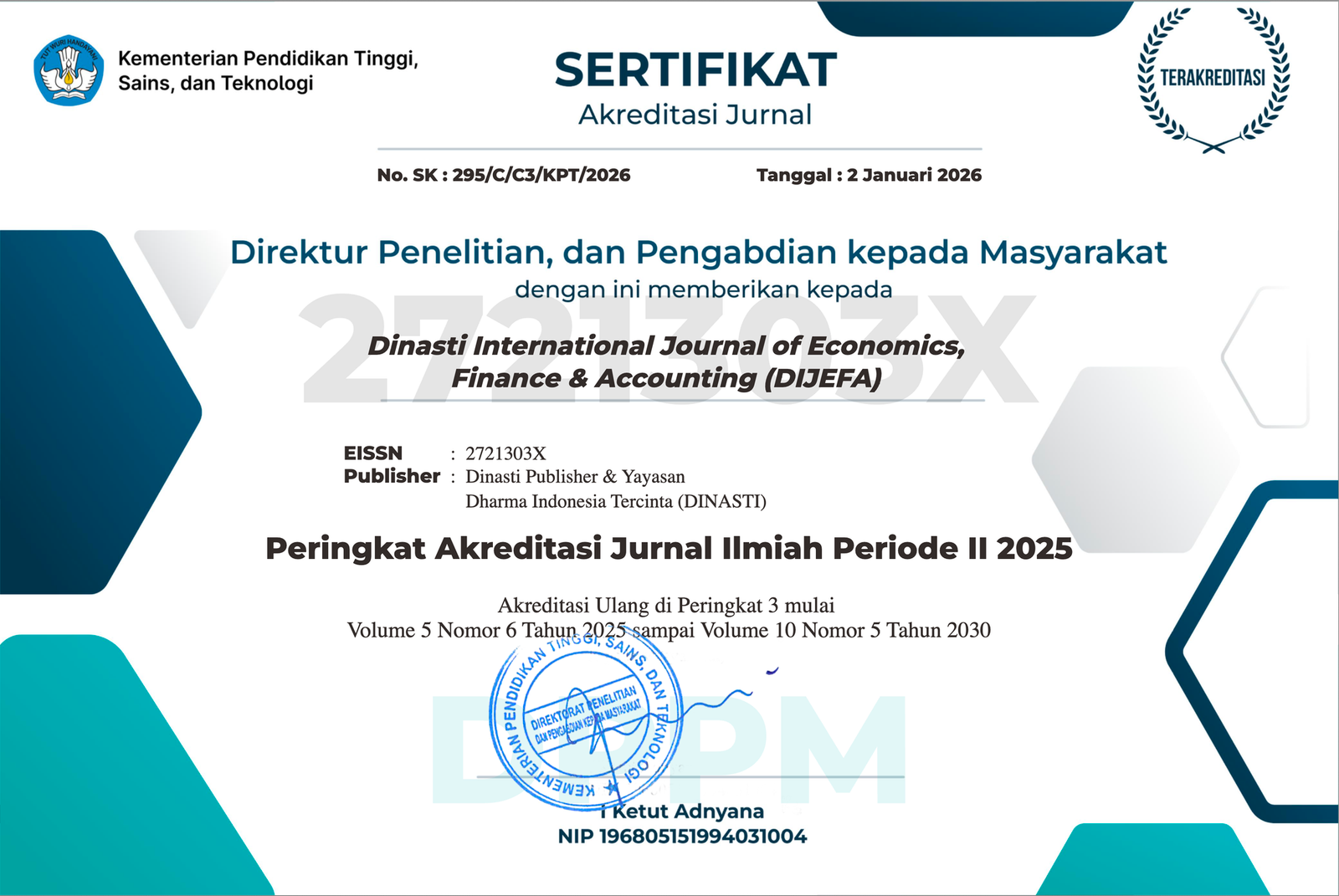
- The author acknowledges that the Dinasti International Journal of Economics, Finance & Accounting (DIJEFA) has the right to be the first to publish with a Creative Commons Attribution 4.0 International license (Attribution 4.0 International (CC BY 4.0).
- Authors can submit articles separately, arrange for the non-exclusive distribution of manuscripts that have been published in this journal into other versions (e.g., sent to the author's institutional repository, publication into books, etc.), by acknowledging that the manuscript has been published for the first time in the Dinasti International Journal of Economics, Finance & Accounting (DIJEFA).